The first time I tried easy nail art at home, I used a toothpick, a bottle of drugstore white polish, and absolutely zero idea what I was doing. The result was a mess. Polish everywhere. Smudged dots. A “flower” that looked more like a small splat.
But here is the thing that messy first attempt is exactly how every person who is now great at nail art got started. Not with a full professional kit and years of training. With a toothpick and a willingness to try.
If you have been staring at nail art videos on TikTok or saving pins on Pinterest and thinking “I could never do that at home,” this article is written specifically for you. I am going to walk you through the most beginner-friendly nail art designs of 2026, explain every step in plain, simple language, and tell you exactly which household items you can use instead of buying any fancy tools.
No fluff. No overwhelming techniques. Just real, doable nail art that you can start today.
Why 2026 is the Best Year to Start doing Nail Art at Home?
Here is some genuinely good news: the nail art trends that are dominating 2026 are some of the most beginner-accessible the beauty world has seen in years.
Celebrity manicurist Queenie Nguyen told Marie Claire that the overall nail mood for 2026 is shifting toward “refined simplicity” clean, intentional designs with one or two artistic details rather than elaborate, layered nail art that takes hours to complete. That means the looks that are most on-trend right now are also the ones that are easiest to recreate at home.
Polka dots are having a massive moment search for polka dot nail art have surged by 180 percent year over year according to Pinterest trend data. Pastel swirl designs are up 70 percent in search volume. Micro French tips, minimalist accent nails, simple daisy designs, and abstract line art are all at the top of the trend charts and every single one of these is completely doable for a beginner with basic tools or even just items from your kitchen drawer.
Nail art in 2026 has never been more approachable. And you do not need a salon appointment or an expensive kit to participate. You just need to know where to start.
That is what this guide is for.
The Honest Truth about Beginner Nail Art:
Before we get into the designs, let me tell you something that most nail art tutorials skip over: your first few attempts are going to be imperfect, and that is completely fine.
The biggest reason beginners give up on nail art is not because they lack talent. It is because they expect their first attempt to look like the Instagram photos they saved, which were created by professional nail artists with years of practice and professional lighting.
Here is a more realistic expectation: your first polka dots might not be perfectly even. Your first swirl might be a little lopsided. Your first French tip might have a slightly wobbly line. And all of that is absolutely okay, because imperfect nail art still looks intentional and creative when it is done with confidence and sealed with a top coat.
The beginner designs in this guide are specifically chosen because they are forgiving. Small irregularities in dots, lines, and swirls actually add to the handmade, artistic quality of the design. You are not trying to be a nail machine. You are trying to make something beautiful, and beautiful things do not have to be perfect.
With that said, here is everything you need to know to get started.
What You Actually Need to Start Doing Nail Art at Home:
You do not need to spend a lot of money. You do not need a full nail art kit. Here is the honest minimum you need to begin:
Tools You Already Have At Home:
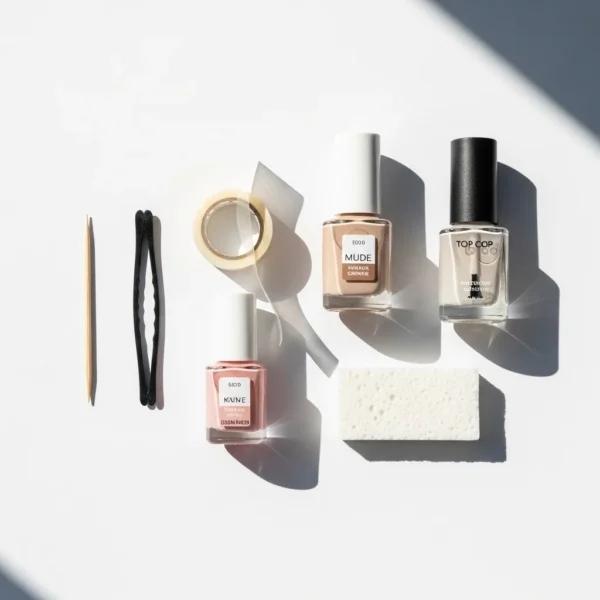
Toothpick: This is the single most versatile beginner nail art tool in existence. The pointed end makes small dots and fine details. The blunt end makes slightly larger dots. You can drag it through wet polish to create swirls, flowers, hearts, and marble effects. It costs nothing.
Bobby pin: The rounded end dipped in polish creates a clean, round dot. Perfect for polka dots and flower petals.
Scotch tape or striping tape: Pressed onto a dry base coat and then painted over, tape creates perfectly clean lines and geometric designs that look incredibly precise even for a first-timer.
Makeup sponge: A small piece torn from a regular makeup wedge sponge creates a beautiful soft gradient or ombre effect when dabbed over a base color.
Tools Worth Buying If You Want To Level Up:
Dotting tool: A double-ended dotting tool runs about five dollars at Ulta, Sally Beauty, or on Amazon. It gives you two consistent dot sizes and is much easier to use than a toothpick for dot-heavy designs.
Thin nail art liner brush: For fine lines, swirls, and simple designs. A set of five nail art brushes runs about eight to twelve dollars on Amazon and will transform what you are able to create at home.
Striping tape: Clear adhesive tape cut into thin strips, available at any nail supply store for a dollar or two. It creates perfect geometric lines.
Supplies Every Beginner Needs Regardless:
Clear base coat: Apply this before any color. It protects your natural nail and helps polish stick better and last longer. Sally Hansen, Essie, and OPI all make excellent base coats available at any drugstore.
Two to three nail polish colors: You do not need a massive collection. For beginner designs, a light base color, a contrasting color for the design, and optionally a third accent color is all you need.
Glossy top coat: This is non-negotiable. It seals your design, protects it from chipping, and gives your nails that high-shine, professional finish that makes even simple designs look expensive. Seche Vite and OPI Top Coat are two of the best available at Ulta and Sally Beauty.
Nail polish remover and cotton swabs: For cleaning up around your cuticles after you paint. This one step makes the biggest difference between a manicure that looks homemade and one that looks done.
How to Prep your Nails Before any Nail Art:
Good prep is what separates nail art that lasts five days from nail art that chips the same afternoon. Take five minutes to do this right and your designs will hold up significantly better.
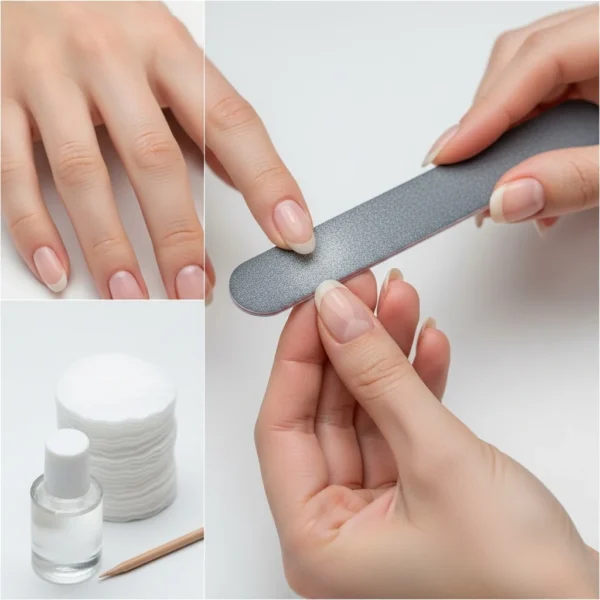
Step 1: Remove all old polish completely using an acetone-based nail polish remover. Acetone removes polish more thoroughly than non-acetone formulas and leaves a cleaner surface for your new color.
Step 2: File your nails into your preferred shape. For nail art beginners, oval and soft square shapes are the most forgiving. Use a file in one direction only — sawing back and forth weakens the nail edge over time.
Step 3: Lightly buff the surface of each nail with a fine buffer block. This smooths out ridges and removes surface shine, which helps base coat bond better.
Step 4: Push back your cuticles gently with an orange stick or a cuticle pusher. You do not need to cut them — just push them back. Well-maintained cuticles make every manicure look more finished.
Step 5: Wash your hands and dry them completely. Any oil or lotion residue on the nail surface will prevent polish from adhering properly.
Step 6: Apply one thin, even layer of clear base coat over every nail. Let it dry for two full minutes before applying any color.
Now you are ready to paint.
The Golden Rules of Nail Art for Beginners:
These are the things nobody tells you until you have already made the mistake. Read them before you start any design.
Always practice on paper first. Load your toothpick or brush with polish and make your dots, lines, or swirls on a piece of paper before touching your nail. This tells you how the polish flows and how much pressure to use. One minute of paper practice saves five minutes of nail polish remover cleanup.
Work on one nail at a time. Do not paint all ten nails with your base color and then start the art. Do the base color on two or three nails, let it dry, do the art on those nails, and then move on. Polish dries out and gets difficult to work with quickly.
Let each layer dry fully before adding the next. This is the rule that beginners break most often, and it is the cause of most smudging disasters. If your base color is still even slightly tacky when you add art on top, the brush or toothpick will drag through it. Wait. Be patient.
Thin coats, always. One thick coat of polish takes forever to dry and bubbles easily. Two thin coats dry faster, look smoother, and last longer. This applies to your base color, your art, and your top coat.
Clean up your edges last. After your design is fully dry, dip a small brush or cotton swab in nail polish remover and clean up any polish that got on your skin or cuticles. This step alone makes your manicure look ten times more finished.
Seal everything with top coat. No design is complete without top coat. It protects your work and makes even the simplest design look polished and deliberate.
8 Easy Nail Art Designs for Beginners Step by Step:
These are ordered from the simplest to the slightly more involved, so you can start at the very beginning and build confidence as you go.
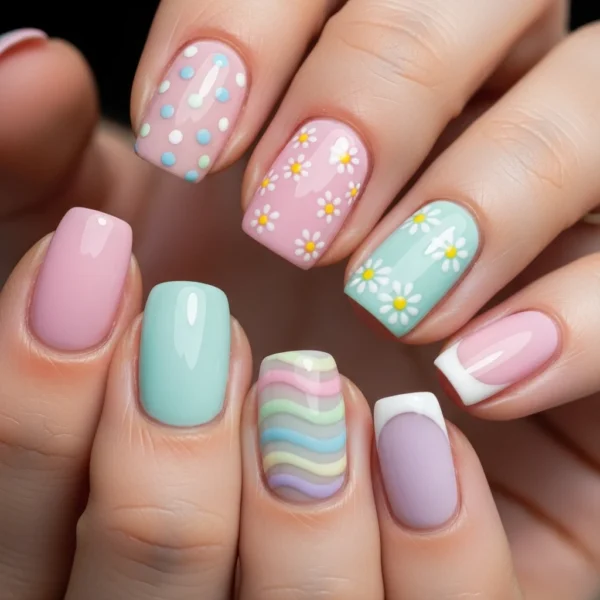
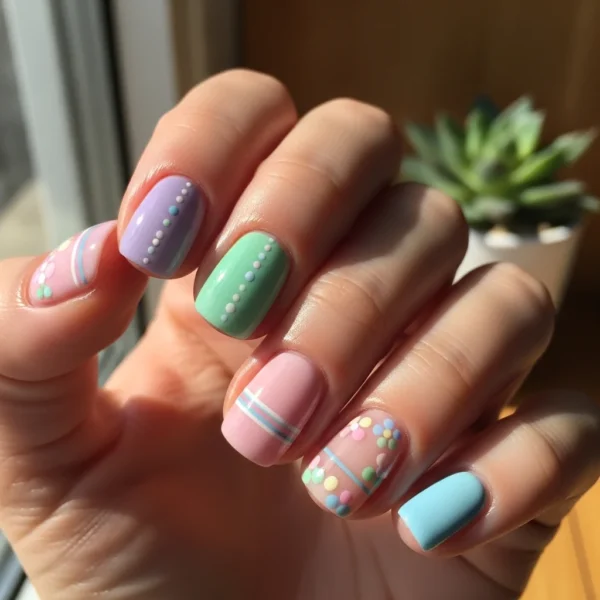
DESIGN 1: POLKA DOTS Best Tool: Toothpick or bobby pin Difficulty: Absolute beginner Why It Works: Polka dots are the most forgiving nail art design that exists. Even dots that are slightly different sizes look intentional and cute. This is genuinely the perfect starting point.
Searches for polka dot nails have surged 180 percent year over year in 2026, making this not just easy but also one of the most on-trend designs you can do.
How to do it:
Apply your base coat and let it dry. Apply two thin coats of your base color — soft white, pastel pink, baby blue, or any light shade and let each coat dry fully.
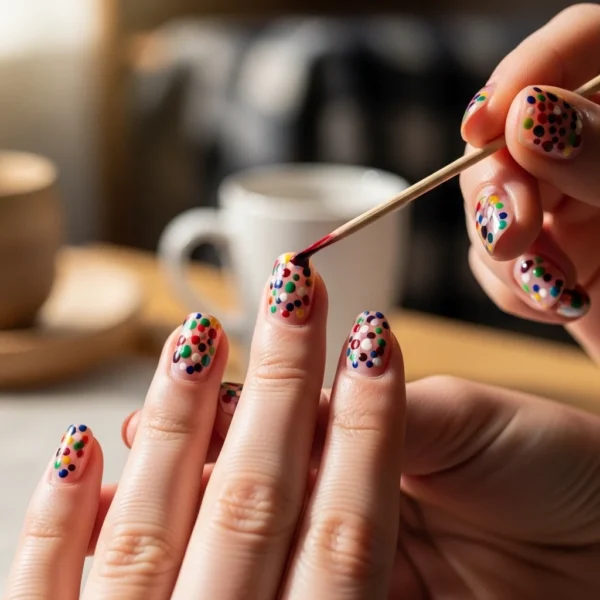
Dip the rounded tip of a bobby pin or the blunt end of a toothpick into your contrasting polish. Press it straight down onto the nail and lift cleanly. That is your dot.
Re-dip the tool for every single dot. Using the same polish on the tool without re-dipping gives you inconsistent dot sizes and shapes.
Place your dots in a pattern you like scattered randomly across the nail for a playful look, arranged in neat rows for a more graphic look, or clustered in the corner of the nail for a minimalist look.
Let the dots dry completely at least 3 to 5 minutes before applying top coat.
Seal with glossy top coat.
2026 Trending Twist: Try pastel multicolor dots scattered across a sheer white base. Use three different pastel shades and place the dots randomly for a playful, confetti-inspired look that is everywhere on Pinterest right now.
DESIGN 2: SIMPLE FRENCH TIP Best Tool: Thin brush or tape Difficulty: Beginner Why It Works: French tips are timeless, universally flattering, and look polished on every nail length. The 2026 version uses a thinner, more delicate white tip than the classic thick white band — called a micro French tip – which is actually easier to paint cleanly because there is less area to fill.
How to do it:
Apply base coat and two coats of your chosen base color. A sheer pink, soft cream, or milky white all work beautifully. Let everything dry completely.
TAPE METHOD (easiest): Place a small strip of scotch tape curved across the nail at the tip, leaving just the very edge of the nail exposed above the tape. Paint white polish over the exposed tip. Remove the tape immediately while the white polish is still wet — do not wait for it to dry. This gives you a perfectly clean, crisp line every time.
FREEHAND METHOD: Load a thin liner brush with white polish and draw a thin curved line across the tip of the nail, following the natural curve of the nail edge. For a micro French tip, make the line very thin — barely a millimeter wide.
Let the tip dry fully. Apply top coat.
2026 Trending Twist: Instead of white, try a soft pastel tip — baby pink over a white base, or soft lavender over a creamy base. Pastel French tips are one of the most searched nail designs of the year.
DESIGN 3: SINGLE ACCENT NAIL Best Tool: Any — this design uses whatever technique you like Difficulty: Absolute beginner Why It Works: An accent nail is the easiest way to make your manicure look intentional and editorial without committing to doing nail art on all ten fingers. You paint nine nails one solid color and do any design you want on the tenth — typically the ring finger. Minimalist accent nail art is the top recommendation for first-timers by professional nail artists right now.
How to do it:
Apply base coat and two coats of your chosen color on all ten nails. Let dry fully.
On your ring finger on each hand, add your accent design. This can be anything — a couple of polka dots, a simple swirl, a glitter gradient, or even just a different color entirely.
The beauty of the accent nail is that because you are only doing the design on one nail, you have more time and focus to make it look really good. And even if it is slightly imperfect, it still reads as stylish and deliberate.
Seal everything with top coat.
2026 Trending Twist: Paint your ring finger in a chrome or metallic shade while keeping the other nine nails a matte solid color. The contrast between matte and shine is extremely on-trend and requires zero artistic skill.
DESIGN 4: SIMPLE DAISY FLOWERS Best Tool: Toothpick Difficulty: Easy beginner Why It Works: Daisy nail art looks incredibly detailed and impressive but is made entirely of dots — which means if you can do polka dots, you can do daisies. This is one of the most-saved beginner nail art designs on Pinterest and TikTok every spring.
How to do it:
Apply base coat and two coats of your base color. A soft white or pastel yellow base works especially well for daisies. Let dry completely.
Dip your toothpick into white polish. Place five small dots in a loose circle on the nail — these are your petals. The dots do not need to be perfectly even. A slightly organic, imperfect circle of petals looks more like a real flower.
Let the white petal dots dry for about two minutes.
Dip the toothpick into yellow polish and place one single dot in the very center of the five white petals. This is the center of your daisy.
You can place one large daisy in the center of the nail, two smaller daisies side by side, or a cluster of three tiny daisies in the corner of the nail. All three arrangements look great.
Let everything dry and seal with top coat.
2026 Trending Twist: Add a tiny dot of green polish between the petals of each flower for a subtle leaf effect. Or mix daisy designs with a couple of scattered pastel polka dots on the same nail for a playful mix-and-match look.
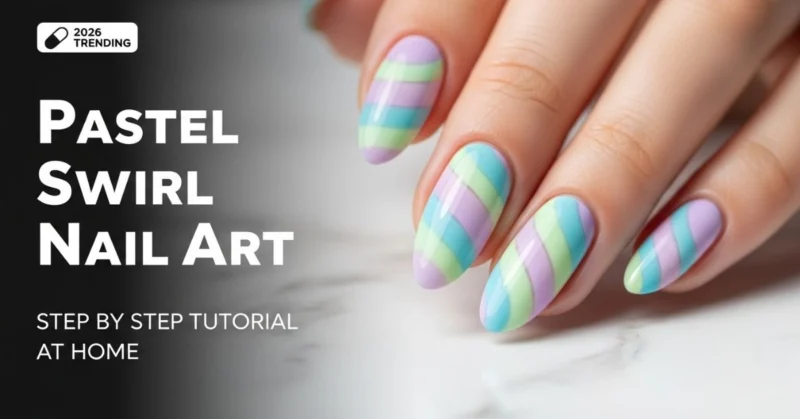
DESIGN 5: ABSTRACT SWIRL Best Tool: Toothpick or thin liner brush Difficulty: Easy beginner Why It Works: Abstract swirl nails look incredibly artistic and complex but are genuinely one of the most forgiving designs a beginner can attempt. The imperfect, organic quality of a handmade swirl is literally the point of the design — no two swirls are ever the same, and that is the beauty of it. Pastel swirl nails have seen a 70 percent increase in searches over the past year.
How to do it:
Apply base coat and two coats of a soft white or creamy base color. Let dry fully.
While the second base coat is still very slightly tacky — not wet, but not fully hard — place two or three small drops of a contrasting pastel color directly onto the nail. You can use one color or two colors placed close together.
Immediately pick up your toothpick and drag it through the color drops in one smooth, flowing motion. Try a loose S-curve, a gentle spiral, or a simple wave motion. Move confidently and quickly.
Do not go back and drag through the color again. One or two passes is what gives you a clean, distinct swirl. Too many passes blend everything into a flat color.
Let dry and seal with top coat.
2026 Trending Twist: Try lavender drops swirled into a soft white base for the most pinned swirl combination of the year. Or use mint green and baby blue drops together for a cool-toned, water-inspired swirl effect.
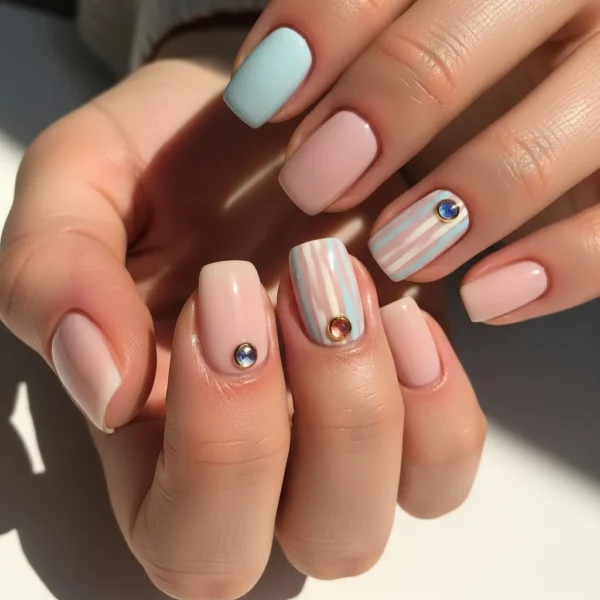
DESIGN 6: TAPE STRIPE NAILS Best Tool: Scotch tape or striping tape Difficulty: Easy beginner Why It Works: Tape does all the work for you. Even someone with the shakiest hands on the planet can achieve perfectly clean, straight lines using tape. This is the number one beginner hack for geometric nail designs.
How to do it:
Apply base coat and two thin coats of your base color. This is very important – let the base color dry completely and fully before placing tape on it. If the base is even slightly tacky, the tape will lift the color when you remove it and ruin the design.
Cut thin strips of tape and place them diagonally, vertically, or in a cross pattern across the nail. Press the tape down firmly, especially along the edges.
Paint your contrasting color over the entire nail, covering both the tape and the exposed areas. Work quickly.
While the top color is still wet, peel the tape off in one smooth, confident motion. The tape will lift away cleanly, revealing the perfect line of your base color underneath.
Let dry and apply top coat.
Design ideas using tape: diagonal two-tone nails (tape across the middle at an angle, two different colors on each half), vertical stripe nails (tape in the center, paint both outer sides), geometric corner nails (tape from corner to corner, paint one triangle).
2026 Trending Twist: Use metallic or chrome polish for the painted section and keep the base a matte solid. The contrast between chrome and matte is one of the biggest nail trends of the year.
DESIGN 7: GLITTER GRADIENT TIPS Best Tool: Makeup sponge Difficulty: Easy beginner Why It Works: The sponge does the blending for you. You do not need any artistic skill to create a gradient — just a piece of foam makeup sponge and a glitter polish. The irregular, textured quality of sponge application looks intentional and artistic rather than imprecise.
How to do it:
Apply base coat and two coats of your chosen base color. Let dry fully.
Dip a small piece of torn makeup sponge into a glitter polish or a sparkly metallic polish. Do not soak the sponge – just lightly coat the surface.
Dab the sponge repeatedly onto the tip of your nail in a bouncing, patting motion. Start at the very tip and work slightly inward, letting the glitter fade naturally as you move toward the center of the nail.
Build up the gradient gradually with several light layers rather than one heavy application. This gives you more control over how far the gradient extends.
Let dry thoroughly – glitter polish takes a little longer to dry than regular polish. Apply a generous top coat to smooth over the texture of the glitter.
2026 Trending Twist: Try a pastel-to-glitter gradient – a soft pink base with rose gold glitter tips, or a mint green base with holographic silver glitter at the tips. These combinations are trending heavily on TikTok nail content right now.
DESIGN 8: SIMPLE HEART NAILS Best Tool: Toothpick Difficulty: Easy beginner Why It Works: Hearts look complicated but are made with a two-step process using a toothpick that anyone can master in about two minutes of practice. This design has been one of the most-searched beginner nail art tutorials for years and remains one of the most popular DIY designs of 2026.
How to do it:
Apply base coat and two coats of your base color. Let dry completely.
Dip your toothpick into your chosen heart color — red, pink, white, or any color you like.
Place two small dots side by side on the nail, touching each other. These form the top of the heart.
Without reloading the toothpick, press it gently between the two dots and drag downward and inward in a V motion to create the point at the bottom of the heart. The two dots will pull together into a recognizable heart shape.
Practice this motion on paper two or three times first — the downward drag is the key step and takes a single practice try to get comfortable with.
Let dry and seal with top coat.
2026 Trending Twist: Place a tiny white heart over a deep berry or burgundy base on just your ring fingernails for a minimal, elegant look. Or place a cluster of three tiny hearts in different shades of pink in the corner of the nail for a maximalist-but-sweet effect.
How to Make you Beginner Nail Art Longer:
One of the most common complaints from people who do their own nails at home is that the designs chip quickly. Here is why that happens and exactly how to stop it:
The number one reason beginner manicures chip fast is not using a base coat. Polish applied directly to the natural nail without a base coat has nothing to grip and peels away quickly. Always use a base coat.
The number two reason is not capping the tips. When you apply your base color and your top coat, drag the brush slightly over the very free edge of your nail tip. This seals the edge and is what prevents chipping from the ends first — which is how most chips start.
The number three reason is exposing fresh nails to water too quickly. Wait at least two hours after finishing your manicure before washing dishes, showering, or swimming. Water softens fresh polish significantly.
To make any design last a full week: Apply a fresh thin layer of top coat every two to three days. It refreshes the shine and adds another protective layer over the design without needing to redo the art.
Common Beginner Mistakes and How to Fix Them:
The base color is not dry and the art design is smearing.
Fix: Stop immediately. Do not try to rescue a wet design by adding more polish. Wait for everything to dry fully, then use a cotton swab dipped in acetone to carefully remove just the smeared art. Let the base dry again and redo the art layer only.
The dots are not round and look like blobs.
Fix: You are either using too much polish on your tool or pressing too hard. Dip less polish and press more lightly. The dot should form from the surface tension of the polish, not from pushing it out of the tool.
The tape is lifting the base color when you peel it.
Fix: Your base color was not fully dry when you placed the tape. It needs to be completely hard, at least 5 to 7 minutes of drying time, not just slightly tacky. Give it more time.
The top coat is dragging through your design.
Fix: The design is not fully dry yet. Let the art dry for at least 5 minutes before applying the top coat. When applying the top coat, start at the center of the nail and sweep outward to the edges. Do not go back and forth, as this drags wet polish underneath.
There is polish on your skin and cuticles.
Fix: This is completely normal and easy to fix. Once everything is fully dry, dip a small pointed brush or a cotton swab in acetone nail polish remover and carefully trace along the edge of each nail to clean up the skin. Take your time. This cleanup step makes a bigger difference than almost any other step.
Best Nail Polish Brands for Beginners in 2026:
You do not need expensive polish to do nail art, but you do want polish that applies smoothly and has a good brush that is easy to control. Here are the best options for beginners available at Ulta, Target, Walgreens, or Amazon:
Essie is one of the best drugstore nail polish brands for consistent color payoff and a well-shaped brush that makes application easy. Their pastel range is excellent for beginner nail art.
Sally Hansen is widely available at most drugstores and Target. The Sally Hansen Miracle Gel line gives a longer-lasting result without a UV lamp, which is great for at-home beginners.
OPI is slightly more expensive than typical drugstore options, but the formula is very smooth and the brush is easy to control. It is available at Ulta and Sally Beauty.
Zoya is known for being free of harsh chemicals. Their polishes have a beautiful formula and an excellent color range. They are available on the Zoya website and at select Ulta locations.
For white polish specifically, which you will use often in beginner nail art, OPI Alpine Snow and Essie Blanc are both highly pigmented whites that cover in one to two coats without being streaky.
Conclusion
If you have read this entire guide and you are still feeling slightly nervous about trying nail art at home, here is the most honest piece of advice I can give you: start with something even simpler than you think you need to.
Do not start with a five-color swirl design. Start with two white polka dots on one nail and see how that feels. Get comfortable with the toothpick. Feel what it is like to dip, press, and lift cleanly. Do that twice. Do it five times. Then try three dots. Then try a small flower.
Every single person who is now confident doing nail art at home went through this exact process of starting small and building from there. The 2026 nail trend moment with its emphasis on minimal, clean, intentional designs is genuinely the best environment there has ever been for a beginner to start. You do not need to do something complicated to look like you know what you are doing. A clean base coat, two white polka dots on a ring finger, and a glossy top coat looks stylish, intentional, and completely on-trend.
Start there. Then keep going.
Try one of the designs from this guide this weekend, take a photo, and drop it in the comments below. We want to see your first attempt dots, hearts, swirls, and all.
Also Read: Lace Nail Art Tutorial – How to Do Doily Nails at Home Step by Step in 2026
Frequently Asked Questions about Beginner Nail Art:
1. Can I do nail art on very short nails?
Yes, absolutely. Short nails are actually perfect for beginner nail art because there is less surface area for mistakes to show up. Polka dots, French tips, small hearts, and single accent designs all look beautiful on short nails. The micro French tip trend of 2026 was practically designed for short nails.
2. What is the easiest nail art design for a complete first-timer?
Polka dots using a toothpick or bobby pin. It requires no technique beyond dipping and pressing, the results look great even when imperfect, and it only takes about five minutes per hand. Start here on your first attempt.
3. Do I need a UV lamp for nail art at home?
No. All the designs in this guide use regular nail polish, which dries in air without any lamp. If you want to use gel polish for longer-lasting results, you will need a UV or LED lamp, but it is not required to start doing nail art at home as a beginner.
4. How do I fix a mistake without ruining the whole nail?
If the polish is still wet, dip a pointed cotton swab into acetone and carefully blot the mistake do not smear it. Let what remains dry, then touch up that area with fresh polish once it is set. If the mistake is fully dry and large, it is sometimes easier to remove the entire nail and start fresh than to try to paint over it.
5. How long does it take to get good at nail art?
Most beginners see a significant improvement in their results within just two to three practice sessions. Nail art is a skill that builds surprisingly quickly, especially for beginner-friendly designs like the ones in this guide. The more you practice, the more natural the hand movements become. By your fourth or fifth attempt at any single design, it will look noticeably cleaner and more confident than your first try.
6. Is nail art bad for your nails?
Nail art done correctly with a proper base coat applied first is not harmful to natural nails. The base coat is what protects your nail from pigment staining and from drying out due to prolonged contact with nail polish. Removing polish with an acetone-based remover occasionally is fine — just apply cuticle oil after removal to rehydrate the nail and surrounding skin.
7. Can I do nail art without any tools at all?
Yes. The polish brush that comes with your nail polish bottle can create lines, swirls, dots, and simple designs on its own. Household items — toothpicks, bobby pins, scotch tape, makeup sponges, and even the eraser end of a pencil — replace every single specialized nail art tool for beginner designs. You do not need to buy anything extra to start.

I’m Ava Thompson, a certified nail artist and beauty educator from Los Angeles, CA. After nearly a decade working at high-end salons, I became obsessed with helping women recreate salon-quality nails at home. I’ve personally tested hundreds of tools and polishes — drugstore and professional grade — so every tutorial I write is based on real experience, not just pretty pictures. My goal at Dhamaka Mirchi is simple: help you nail it on the first try, without spending a fortune.