I have been doing my own nails at home for years, and I will be honest with you — when lace nail art first started showing up all over my TikTok and Pinterest feeds, my first thought was “there is absolutely no way I am pulling that off without a professional.” It looked so intricate. So detailed. So impossibly delicate.
But then I tried it.
And I am here to tell you that lace nail art is far more achievable at home than it looks. You just need the right technique, the right tools, and a little patience. In this tutorial, I am going to walk you through everything — from the simplest beginner-friendly method using nail stamps, all the way to hand-painting your own lace designs if you want to go full artist mode.
Before we get into the how-to, let me tell you why you should care about this particular trend right now.
Why Lace Nail Art is the Biggest Nail Trend of 2026:
Lace nails are not just trending – they are one of the defining nail looks of the entire year.
Pinterest Predicts 2026 officially called “Laced Up” as one of its top trends for the year, covering fashion, beauty, and accessories. As part of that announcement, Pinterest reported that searches for lace nails specifically had increased by a staggering 215 percent over the past year. That is not a small blip. That is a full-on movement.
Celebrity nail experts have confirmed it too. Chanel and celebrity nail artist Betina Goldstein told Vogue that lace and silk-inspired nail designs would be among the most popular looks of 2026, calling the trend “delicate yet highly detailed.” And Metta Francis, founder of Nails by Mets, told Who What Wear that lace nail art is officially “big news in 2026,” noting that the look can be worn as an accent nail or paired beautifully with a French tip.
The reason lace nails resonate so deeply right now has a lot to do with the broader aesthetic moment we are living in. The coquette trend, balletcore, vintage romanticism, and the resurgence of feminine softness across fashion have all created a cultural appetite for this kind of delicate, detailed beauty. Lace nails are the perfect expression of that energy — they are romantic without being overdone, elegant without being stiff, and artistic without requiring you to be a trained nail technician.
They work for everyday wear, bridal manicures, date nights, and even office looks when done in softer colorways. And as you are about to find out, they are absolutely something you can create at home.
Popular Lace Nail Designs to Try at Home in 2026
Now that you know the technique, here are the specific design ideas that are trending most right now:
White Lace on Milky White Base:
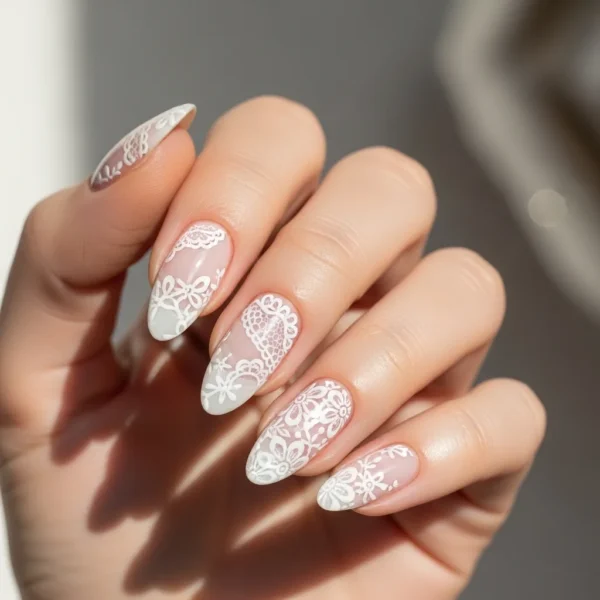
This is the most elegant and most popular lace nail look right now. The tone-on-tone approach gives a soft, subtle result that reads as incredibly refined and expensive-looking. It is also perfect for brides or anyone who wants something romantic without being loud.
Black Lace on Black Base:
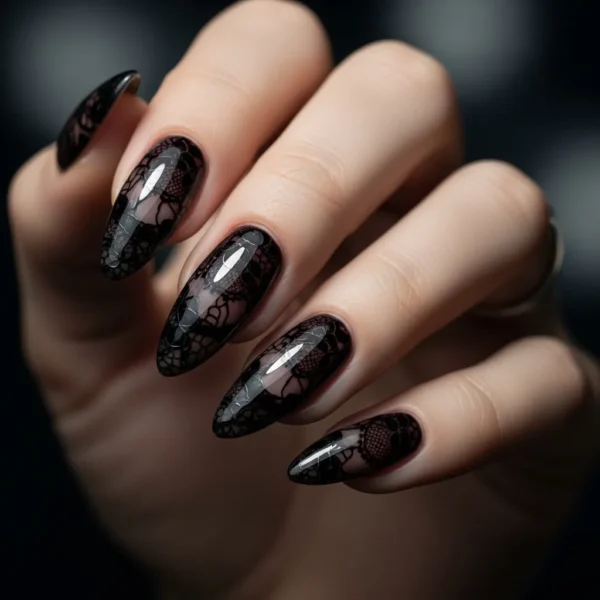
Moody, dramatic, and deeply sophisticated. A sheer dark base with black lace painted over it in intricate patterns is one of the most striking nail looks of the year. The lace design becomes visible through the light catching the fine lines against the deeper base.
White Lace on Black Base:
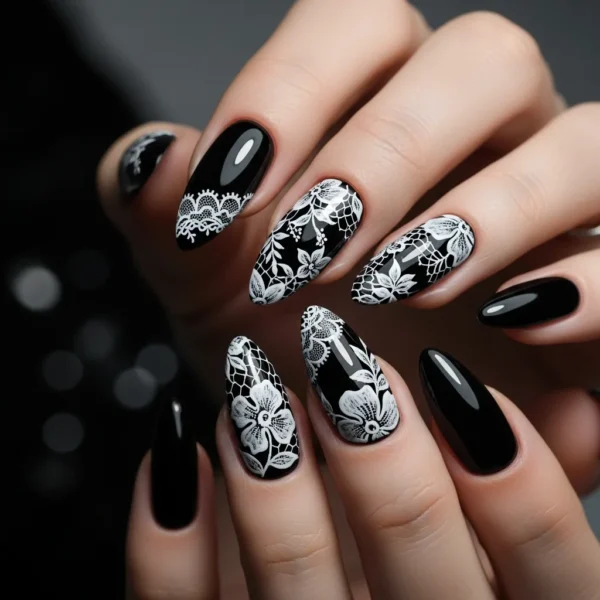
The highest contrast version and the most visually striking. Crisp white lace painted over a true black base looks bold, gothic-romantic, and extremely editorial. This is the version that gets the most saves on Pinterest right now.
Lace French Tips:
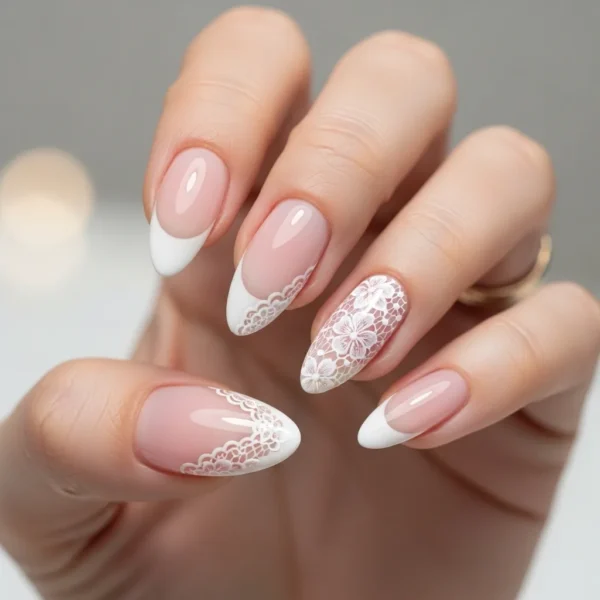
Instead of a traditional solid French tip, replace the white tip with a scalloped lace border followed by delicate floral motifs. This is the modern French manicure update that nail artists like Metta Francis are specifically calling out as one of the standout looks for 2026.
Coquette Lace Accent Nails:
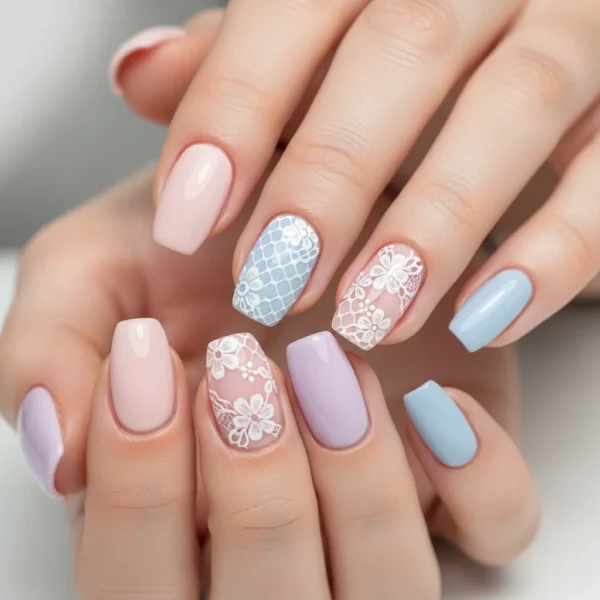
Apply a solid pastel base on most nails and do the lace design on just one or two accent nails — typically the ring finger on each hand. This is a more wearable, approachable version of lace nails that suits everyday life perfectly.
Bridal Lace Nails:
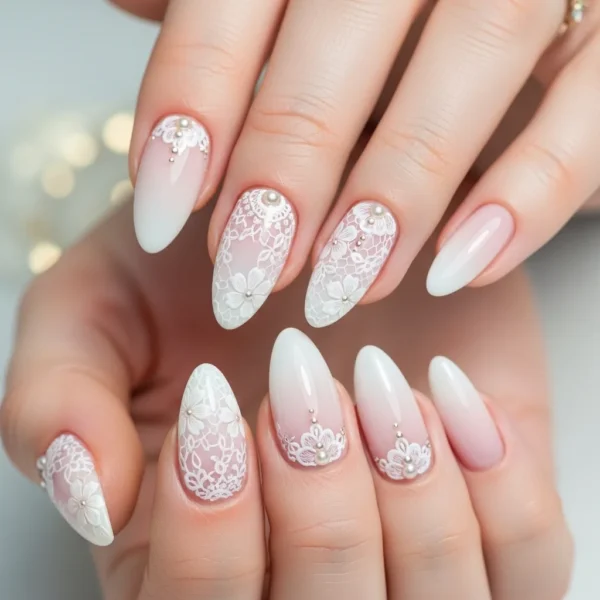
A soft white or blush pink base with delicate white lace patterns and tiny pearl accents placed at the intersections of the lace design. Finish with a satiny or glossy top coat. This is the wedding nail look of the year for 2026 without any question.
Burgundy Base with White Lace:
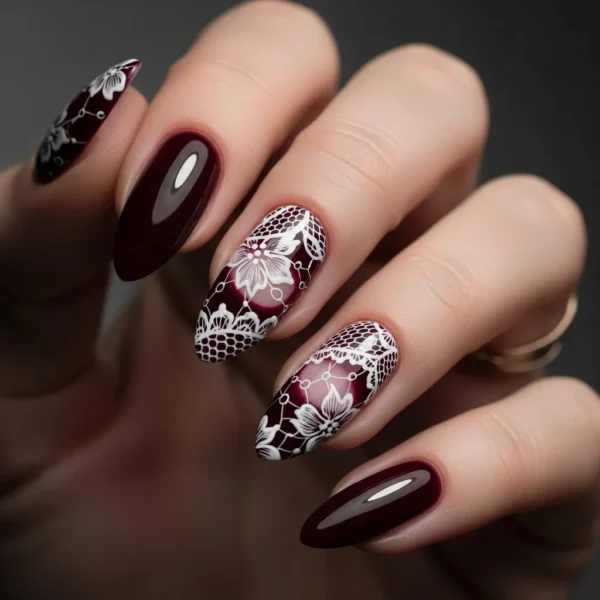
One of the most sophisticated colorway combinations for fall and winter. A rich, deep burgundy base with fine white lace detail on top has an almost Victorian elegance to it that is completely stunning in person.
What Exactly are Lace Nails and Doily Nails?
Before we get into the tutorial, let us clarify what we actually mean when we talk about lace nails versus doily nails, because there is a slight difference.
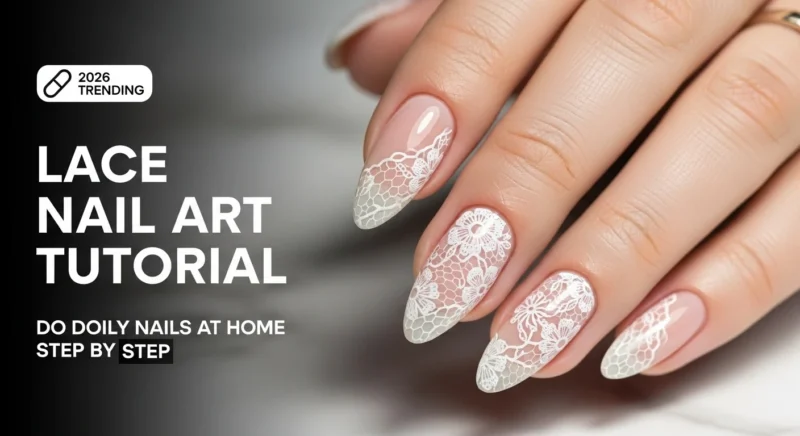
Lace nails is the broad term for any nail design that replicates the look of fabric lace — those intricate, interlocking patterns of floral motifs, scalloped edges, and fine mesh that you see on lingerie, wedding dresses, or vintage tablecloths. The pattern can run across the entire nail or just along the tip.
Doily nails specifically refer to designs that replicate the look of a paper or fabric doily — the round, circular lace patterns with repeated geometric or floral motifs radiating outward from a center point. Think of the lace coasters your grandmother used to put under flower vases. That circular, symmetrical pattern is what makes doily nail art so distinctive and so satisfying to look at.
Both styles fall under the lace nail umbrella, and in this tutorial we will cover how to achieve both – the flowing lace pattern and the more geometric doily style.
Three Ways to do Lace Nail Art at Home
Here is something that most tutorials do not tell you upfront: there is not just one way to do lace nails. There are actually three distinct methods, and each one suits a different skill level and gives a slightly different result.
Method One: Nail Stamping (Best for Beginners)
Nail stamping is hands down the fastest and most beginner-friendly way to get lace nail art at home. You use a pre-engraved metal stamping plate that has lace patterns etched into it, fill the pattern with polish, transfer it onto a silicone stamper, and then press it directly onto your nail. The result looks extremely intricate and professional, and the whole process takes only a few minutes per nail once you get the hang of it.
This is the method I recommend if you are doing lace nails for the first time. It removes all the pressure of trying to hand-paint fine details and still gives you a genuinely impressive finished look.
Method Two: Nail Stickers and Decals (Easiest of All)
If you want the look of lace nails with zero technique required, nail stickers and lace decals are your answer. You apply a base color, let it dry completely, and then place a pre-made lace sticker or water transfer decal directly onto the nail. Seal it with top coat and you are done.
The result is not quite as custom or unique as stamping or hand-painting, but for a quick manicure that still looks genuinely on-trend, this method is completely valid and incredibly popular right now. Brands like Kiara Sky, Static Nails, and imPRESS have all released lace-patterned press-ons and nail art stickers specifically for 2026.
Method Three: Hand-Painting (Best for Advanced or Patient Beginners)
Hand-painting lace is the most artistically satisfying method, and it gives you the most control over your design. You use a very thin nail art liner brush – sometimes called a striping brush loaded with nail polish to draw the lace pattern freehand directly onto a dry base color.
This sounds intimidating, but the truth about lace patterns is that they are made up of very simple, repetitive shapes: small dots, short curved lines, tiny loops, and scalloped edges. Once you break the pattern down into its individual components and practice each one separately on a piece of paper first, the overall design becomes far less scary.
This is the method we will focus on most in the step-by-step guide below, because understanding hand-painting gives you the ability to customize your lace design completely. We will also walk through the stamping method in detail.
Tools and Supplies you Need for Lace Nail art at Home:
Everything on this list is available at Ulta, Sally Beauty, Target, Amazon, or any beauty supply store.
For All Methods:
Clear base coat
Protects your natural nails and gives the polish something to grip onto. Do not skip this step.
Your chosen base color
For classic lace nails, soft white, milky cream, or sheer pink shades are the most traditional choices. For a more dramatic or edgy look, a deep black or rich burgundy base paired with white lace on top looks stunning. For a bridal style, try a sheer cloud white or a pale blush tone.
Glossy top coat
These seals and protects your design. A high-shine top coat also enhances the lace pattern and makes it stand out beautifully. Seche Vite, HK Girl, and OPI Top Coat are all excellent options available at Ulta.
Nail polish remover and cotton swabs
Use these to clean up any excess polish around the edges for a neat, professional finish.
For Hand-Painting Lace:
A thin nail art liner brush – This is the most important tool for hand-painted lace. Look for a brush with a very fine, long tip that holds its shape. Brands like Makartt, Born Pretty, and Modelones all make good liner brushes available on Amazon for around five to ten dollars.
White or black nail polish with a thin, fluid consistency – thicker polish clogs fine brushes and makes detail work much harder. If your polish is too thick, add one small drop of nail polish thinner and roll the bottle gently between your palms to loosen it.
A dotting tool – For placing precise dots that form part of the lace pattern.
For Nail Stamping:
A nail stamping kit – This includes a metal stamping plate with lace patterns, a silicone stamper, and a scraper card. Brands like Bundle Monster, Maniology, and Moyra all make excellent kits with dedicated lace pattern plates. These are available on Amazon and at Sally Beauty.
Stamping nail polish – This is a specific type of polish that is more opaque and pigmented than regular polish, designed to transfer cleanly from the plate to the nail. Sally Hansen Nail Art Pen polishes and any dedicated stamping polish from Bundle Monster work well.
Lace Nail Art Tutorial: Hand-Painting Method – Step by Step:
Let us walk through the hand-painting method in full detail. This takes more time than stamping, but it gives you a genuinely custom result that looks incredible.
STEP 1: Prepare your Nails Properly
Start with completely clean, dry nails. Remove every trace of old polish using an acetone-based remover – acetone removes polish more completely than non-acetone formulas, which matters because any leftover residue can prevent your base coat from bonding correctly.
File your nails into your preferred shape. For lace nail art, oval and almond shapes are the most flattering because their curved edges naturally echo the soft, rounded quality of lace patterns. That said, square and coffin shapes also work beautifully and give the design a more graphic, fashion-forward feel.
Lightly buff the surface of each nail with a fine buffer block. This smooths out any ridges and removes surface shine, both of which help your base coat adhere more evenly. After buffing, wipe each nail with a lint-free pad dampened with nail prep or rubbing alcohol to remove any dust or oil.
Push back your cuticles gently. Well-maintained cuticles make every manicure look more professional and polished. Apply a small drop of cuticle softener, wait 30 seconds, then push back gently with a cuticle pusher or orange stick.
Wash and completely dry your hands before applying any polish.
STEP 2: Apply your Base Coat
Apply one thin, even layer of clear base coat across every nail, including over the free edge. Work from one side of the nail to the other in smooth, even strokes. Let this dry completely before you move on – usually about two minutes in a room-temperature environment.
If you are in a hurry, you can use a quick-dry base coat, but do not skip the base coat entirely. It is what prevents pigment from staining your natural nail and what keeps your manicure lasting longer without lifting or chipping.
STEP 3: Apply your Base Color
Apply two thin, even coats of your chosen base color. Going thin is important – thick coats of polish take much longer to dry and are more prone to bubbling and smudging. Apply your first coat, let it dry until it is just slightly tacky but no longer wet, and then apply the second coat.
For classic white lace on a white base, apply two coats of a creamy or milky white and let it dry fully before any lace work. This gives you a tone-on-tone lace effect that looks incredibly soft and elegant – very bridal and very Pinterest-worthy right now.
For the most dramatic lace look – bold and high contrast – apply two coats of a true black polish and let it dry completely before adding white lace on top.
For something in between, try a soft blush pink, a pale lavender, or a milky cloud white base with white or delicate pastel lace painted over it.
Allow your base color to dry completely before moving on. If it is still even slightly tacky when you start painting lace details on top, the liner brush will drag through the base and ruin the design. Patience here genuinely matters.
STEP 4: Practice the Lace Pattern on Paper First
Before touching your nails, spend five minutes practicing your lace pattern on a piece of paper or a practice nail wheel. This one step alone will improve your final result more than any tip I can give you.
Load your liner brush with your lace polish, press it gently onto the paper, and practice these individual components:
Small dots: Press the very tip of the brush straight down onto the surface and lift cleanly. This creates the small circular dots that appear throughout most lace patterns.
Tiny loops and teardrops: Draw a small upside-down U shape and fill it with a tiny loop. These form the floral motifs at the center of most doily patterns.
Scalloped lines: Draw a series of connected curved arches in a row. This is the scalloped edge that appears along the tip of lace French manicures.
Fine connecting lines: Draw thin, straight lines connecting your motifs to create the mesh or net background that holds a lace pattern together.
Once you can produce each of these elements reasonably cleanly on paper, you are ready to move to your nails.
STEP 5: Paint the Lace Framework onto you Nail
Load your liner brush with white nail polish (or whichever lace color you are using). Remove excess polish on the neck of the bottle so the brush is loaded but not overloaded.
Start by establishing the outer border or framework of your lace design. For a French tip lace look, paint a scalloped line across the tip of the nail – a series of small connected arches running from one side to the other. This forms the lace trim edge and is the most recognizable element of lace nail art.
For a full lace design covering the whole nail, start at the base of the nail near the cuticle and draw a thin curved or straight line as your anchor point. Then build the pattern upward from there in a symmetrical arrangement.
Work slowly and deliberately. Use the side of your wrist resting on your work surface as a stabilizer – never try to paint fine detail while your hand is floating unsupported in the air.
STEP 6: Add the Lace Motifs and Details
Once your framework is in place, begin adding the decorative elements of the lace pattern.
For a classic doily nail: Add small loops and teardrops radiating outward from a central point on the nail, like the spokes of a wheel. Fill the spaces between the spokes with tiny dots or short curved lines. Add a border of scalloped arches around the outer edge of the design.
For a lace French tip: Add tiny floral motifs – a dot surrounded by four to six small petal loops – along the scalloped edge you painted in the previous step. Fill the space between the scalloped edge and the tip with a fine mesh of crossing diagonal lines. Add small dot accents along the scalloped border.
For a minimal lace accent nail: Keep the design very simple – a single scalloped border near the cuticle with a few small dot accents is enough to read as lace and looks extremely elegant.
Do not feel like you need to fill every centimeter of the nail. White space within the lace pattern is actually what makes it read as lace rather than as a busy, cluttered design. The negative space is part of the design.
STEP 7: Add a Second Layer for Opacity if Needed
Once your first layer of lace detail is completely dry, assess the opacity. If any lines look thin or patchy, go back and carefully apply a second thin layer of polish over just those areas. This is easier than trying to paint everything thickly in one go and gives you a much cleaner, crisper result.
STEP 8: Clean Up the Edges
Use a small brush dipped in acetone, or a cotton swab lightly dampened with nail polish remover, to clean up any polish that has landed on your skin or cuticles. Take your time with this step. The difference between a manicure that looks homemade and one that looks salon-done almost always comes down to how well the edges are cleaned up.
STEP 9: Seal with Glossy Top Coat
Apply one generous, even coat of high-shine glossy top coat over the entire nail, covering both the base color and the lace design completely. Make sure to drag the top coat over the free edge of the nail tip to cap it — this prevents the design from chipping from the edges first.
The top coat does two important things. It protects the delicate lace detail from chipping, smudging, or wearing away, and it gives the design a beautiful glass-like finish that makes the lace pattern appear even more intricate and refined.
Let the top coat dry fully — at least 5 to 10 minutes — before doing anything with your hands.
How to do Lace nails with Nail Stamping – Quick Method:
If hand-painting feels too involved for you right now, here is the stamping method broken down simply.
First, apply your base coat and base color exactly as described in steps 1 through 3 above. Let everything dry completely.
Apply a generous drop of stamping polish directly onto your chosen lace pattern on the stamping plate. Immediately scrape across the surface of the plate with the scraper card at a 45-degree angle in one smooth, confident pass. This removes the excess polish and leaves it only inside the etched design.
Press your silicone stamper firmly and evenly onto the design on the plate, then lift it straight up. The lace pattern should now be sitting on the dome of the stamper.
Quickly and confidently press the stamper onto your nail, rolling it slightly from one side to the other rather than pressing straight down. Lift cleanly.
If the transfer is not clean or complete on the first try, remove the polish from your nail with a lint-free pad dampened with acetone, let the base color dry again, and try once more. Stamping has a small learning curve but becomes very natural after two or three attempts.
Seal with top coat as described above.
How Long Do Lace nails Last at Home?
With a proper base coat and a quality top coat applied correctly, hand-painted or stamped lace nails should hold up for 5 to 7 days at home before showing signs of tip wear. To extend the wear as long as possible:
Apply a fresh thin layer of top coat every two days. This refreshes the shine and adds an extra layer of protection over the delicate lace detail. Always wear rubber gloves when washing dishes, cleaning, or doing anything involving prolonged water or chemical exposure. If the very edge of the design starts to lift, do not peel it — use a tiny brush loaded with top coat to reseal the edge immediately.
If you apply your lace design using gel polish and cure it under a UV or LED lamp, the design can last two to three weeks with zero chipping. The stamping method also works with gel stamping polish for those who have a gel setup at home.
Pro Tips for Perfect Lace Nails from the First Try
Keep your liner brush clean. Rinse it in acetone every few nails and wipe it clean on a lint-free pad. Polish that dries on the brush bristles causes dragging and uneven lines.
Use a thinner, more fluid polish for lace detail work. Thick polish clogs fine brushes and creates blobby, heavy lines instead of the delicate, crisp lines that make lace look like actual lace.
Work under good lighting. Lace nail art requires you to see fine details clearly. Natural light or a daylight lamp will show you your work much more accurately than a warm-toned ceiling light.
Let each section dry before adding the next. If you try to paint one lace motif on top of another that is still wet, the brush will lift and smear the work underneath. Patience between each section is what keeps the design clean and crisp.
Less detail reads better at nail scale. A lace pattern that looks sparse and simple on paper will look intricate and full once it is reduced to the scale of your fingernail. Do not overload the nail with detail — restraint is what makes lace nail art look elegant rather than chaotic.
Accent nails are your friend if you are a beginner. Start by doing the lace design on just your ring fingers or thumbs. This lets you practice the technique on real nails without committing to all ten at once, and the finished result still looks intentional and stylish.
Common Mistakes to Avoid When Doing Lace Nail Art:
Starting the lace detail before the base is fully dry. This is the number one mistake beginners make. A base that is even slightly tacky will drag under the liner brush and ruin the design before you have even started. Give the base coat a full 5 minutes to dry before you pick up the detail brush.
Using a brush that is too thick. A regular nail art brush or a regular polish brush will not produce fine enough lines for lace. You need a true liner brush with a very thin, pointed tip. This one tool makes more difference than almost anything else.
Pressing too hard with the liner brush. With fine detail work, the brush should barely touch the nail surface. Use just the very tip of the bristles and let the polish flow naturally rather than forcing it with pressure.
Trying to do all ten nails the same on the first attempt. Lace patterns improve significantly with practice, so your later nails will almost always look better than your first ones. If you are doing a full ten-nail lace set for the first time, accept that it will not be perfect and know that it gets much easier and more natural very quickly.
Skipping the top coat. Without a sealing top coat, the fine lace lines will wear away within a day or two, especially on the nails that experience the most contact. The top coat is not optional — it is what makes the design last.
Also Read: Swirl Nail Art Tutorial – Pastel Swirl Nails Step by Step at Home 2026
Final Thoughts
I came into lace nail art thinking it was reserved for professional nail techs only. I was completely wrong. Yes, hand-painting a full lace doily design takes more care and patience than slapping on a coat of red polish. But it is absolutely something you can learn at home, and the results are genuinely stunning.
The key things to remember are these: let each layer dry fully before moving to the next, use a proper thin liner brush for any detail work, do not overload your nail with too much detail, and always seal everything with a quality glossy top coat.
Whether you go for crisp white lace on a black base, soft tone-on-tone lace on a milky white, or a delicate lace accent nail alongside a simple pastel manicure — you are wearing one of the most searched and most admired nail trends of 2026. And you did it yourself.
Try the lace nail art tutorial this week, take a photo of your result, and share it in the comments below. We want to see what you create. And if you have questions about any part of the technique, drop them below and we will answer every single one.
Frequently Asked Questions about Lace Nail Art
1. Is lace nail art difficult for beginners?
It is more involved than basic nail art like polka dots or simple stripes, but it is absolutely achievable for dedicated beginners, especially using the stamping method. Hand-painting lace takes more practice, but it becomes much easier once you understand that the pattern is just a collection of simple repeated shapes such as dots, arches, loops, and lines, rather than one impossibly complex design.
2. What is the easiest method for lace nails at home?
Nail stamping with a dedicated lace stamp plate is the easiest method that still gives you a genuinely impressive result. Nail stickers and press-ons are even simpler, but they offer less customization.
3. Can I do lace nails on short nails?
Yes. Lace patterns work very elegantly on short nails, especially with the accent nail approach or the lace French tip style. On shorter nails, keep the design simple. A scalloped edge and a few dot accents are enough to create a beautiful lace effect.
4. What nail polish brands work best for hand-painted lace?
For fine detail work, you need a polish that is highly pigmented and has a thin, fluid consistency. Essie, Sally Hansen Insta-Dri, and OPI all offer shades that work well. For white lace details specifically, a gel-effect or slightly thicker formula, such as Zoya Purity or OPI Alpine Snow, provides excellent coverage in a single thin coat.
5. Do I need special tools for lace nail art?
You will need either a nail stamping kit for stamping or a very fine liner brush and a dotting tool for hand-painting. Everything else, including base coat, base color, top coat, and polish remover, is the same as a regular manicure. The liner brush is the most important investment if you want to create detailed nail art at home regularly. A decent set of five nail art brushes costs around ten to fifteen dollars on Amazon and can significantly improve your results.
6. Can I do lace nails with gel polish?
Yes, and the results last significantly longer, typically two to three weeks compared to five to seven days with regular polish. Apply your gel base coat and cure it, then apply and cure your gel base color. Use gel stamping polish for stamping or a gel-consistency nail art paint for hand-painting. Finish with a gel top coat and cure for a sealed, chip-resistant lace manicure.
7. How do I remove hand-painted lace nails?
Remove them the same way you would remove regular nail polish. Soak a cotton pad in acetone-based nail polish remover, press it against the nail for 20 to 30 seconds, and then wipe gently. The entire design, including the base color, lace details, and top coat, will come off cleanly. Avoid peeling or scraping, as this can damage the surface of your natural nails over time.